Anthropology is the comparative, evolutionary and historical study of humankind. Our department takes a theoretically driven, empirically-informed approach to this study, and has special expertise in archaeology, genetics, behavioral ecology, demography, hunter-gatherers, and evolutionary approaches to human behavior. Our regional expertise is strongest in Africa, Australia, New Guinea, Latin America and western North America. We have a small but influential faculty, three of whom (Harpending, Hawkes, O'Connell) are members of the National Academy of Sciences. Many faculty members do research that crosses disciplinary and sub-disciplinary lines, and we encourage students to do the same.
We are pleased to announce that Dr. Leslie Knapp will join the faculty of the University of Utah as Chair of Anthropology during the Summer of 2013. Professor Knapp comes to Utah from Cambridge University, where she has most recently served as Head of the Division of Biological Anthropology. Dr. Knapp, a primate geneticist, is a prolific and well-known scholar whose research spans a variety of topics in primate immunogenetics and molecular ecology. We are delighted to welcome her to the Department and University!
Why do males and females have different reproductive and parenting strategies? This course introduces human life history through the topic of male/female relationships, parenting, and family formation. Some key topics covered include male and female life histories, the ecology of sex differences, reproductive strategies, mate choice, the sexual division of labor, sexual coercion and cooperation, and the evaluation of the human family. Emphasis is placed on examining these aspects of male/female relationships as they are shared across primates, are particular to humans, and as they vary across human societies. The course is designed for students studying anthropology, biology, psychology and other disciplines interested in the relationship between human biology and behavior.
How does our evolutionary past shape who we are today? Why are humans so social? Why do humans form families and have such diverse marriage systems? Why do children mature so slowly and adults live so long? Are we the only species with a sophisticated form of communication? Why are art and religion found in all human societies? This introductory course considers human behavior, sociality, sex differences, cognition, language and art in a broad evolutionary context using the concepts of natural and sexual selection, as well as ecology and life history theory. Variability in human behavior is examined through the use of the fossil record, cross-cultural data from traditional societies and experimental data from contemporary populations.
Anthropology of Clinical Health Care explores the theoretical, methodological and applied models used by clinical anthropologists in the United States and throughout the world. While geared to the field of anthropology, potential clinicians from other fields such as psychology, psychiatry, primary care, public health and social work will find the course useful.
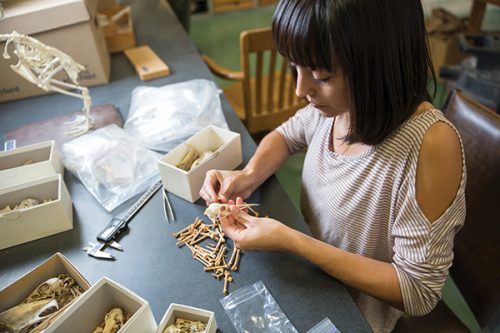
Our knowledge of variability in prehistoric human behavior is based virtually exclusively on archaeological analyses of the physical remains left behind by ancient peoples. Pursuant to this study, Anthropology 2030 reviews the history, goals, theories, and methods of archaeological research, especially as influenced by the natural sciences. Substantive examples are drawn from a diverse set of time periods and geographical locations.
Pleistocene archaeology reviews major issues in human evolution from an archaeological perspective. The course focuses on the Old World Pleistocene (ca. 2.5 million years ago to 10,000 years ago).
How did the island peoples of the Pacific navigate across hundreds of miles of open ocean and successfully colonize the most isolated land masses in the world? what social systems evolved in the Pacific and how do they influence and carry on to the present day? What contemporary cultural and economic issues have arisen with migration? This course introduces students to the cultures of the Pacific islands (past and present), offering lectures and discussion on the social and environmental pressures that have shaped Oceanic societies in the Pacific and migrant communities. In the first half of the course, the student will be introduced to the important environmental, economic, and cultural factors during the colonization and development of the Pacific. The second half will describe the cultural and political changes that have occurred after European contact. A variety of perspectives form archaeology, biology, economics, history,, and cultural anthropology will be used to illustrate the numerous forces that shaped Pacific cultures from the time of the first explorers to today's globalized world. Remarkably, Utah is home to growing Polynesian diaspora groups, and local issues will be emphasized along with the discussion of immigration, remittances, political conflict, adaptation, and globalization. The continuity from the"old" Pacific societies to contemporary societies will be emphasized throughout.
A basic understanding of how data is analyzed is vital to a deeper understanding of anthropological phenomenon. Anthropology 4962-002 (Introduction to Statistical Thinking in Anthropology) is designed for students with little or no experience with statistics. The course introduces basic tools needed to analyze and interpret data sets. The course will focus on practical skills, using examples from anthropology to conduct question-motivated applied statistics. Topics include probability theory, random variables, and statistical models. Students will complete work in the R statistical computing language.
This course serves as an introduction to linguistics, the science of language, focusing on how languages are structured and used, and how they reflect the culture in which they are embedded. Students will learn the basic methodology for studying the structure of a language, necessary for understanding how the world's languages may differ from one another and change over time, how variation in a language may come to be associated with cultural differences, and how human language differs from other communication systems. A wide variety of languages will be explored from speech communities in the U.S. and elsewhere.
The purpose of this course is to develop an understanding of the social factors which correlate with language variation within Western and non-Western societies and the methodology necessary for studying language in its social context. While the focus is on the variation and change model, the course also provides an introduction to multilingualism, language contact, and language endangerment. The prerequisite for this course is a basic introduction to phonetics and phonology.
Department of Anthropology professor Alan Rogers has recently published a paper in the November 28th issue of the Proceedings of the Royal Society B theorizing as to why men in some cultures should be expected to invest resources in their sister's children. Rogers notes: "Men invest in children in many ways--the care for them, feed them, and leave them resources when they die. But in many human societies, these are the children of sisters rather than those of wives. For decades, anthropologists have wondered why." Professor Rogers theorizes that previous attempts to explain such behavior have generally failed because they have miscalculated the number of potential paramours and the individual (female) receptivity to such affairs. For more details, download the full article here.
Department of Anthropology professor Kristen Hawkes has long done research on the evolutionary advantages of human grandmothers. With new data available, her latest article on the "grandmother hypothesis" (recently published in Proceedings of the Royal Society B), includes computer simulations that support the theory of a linkage between human lifespan evolution and the presence of grandmothers. Read more details here.